
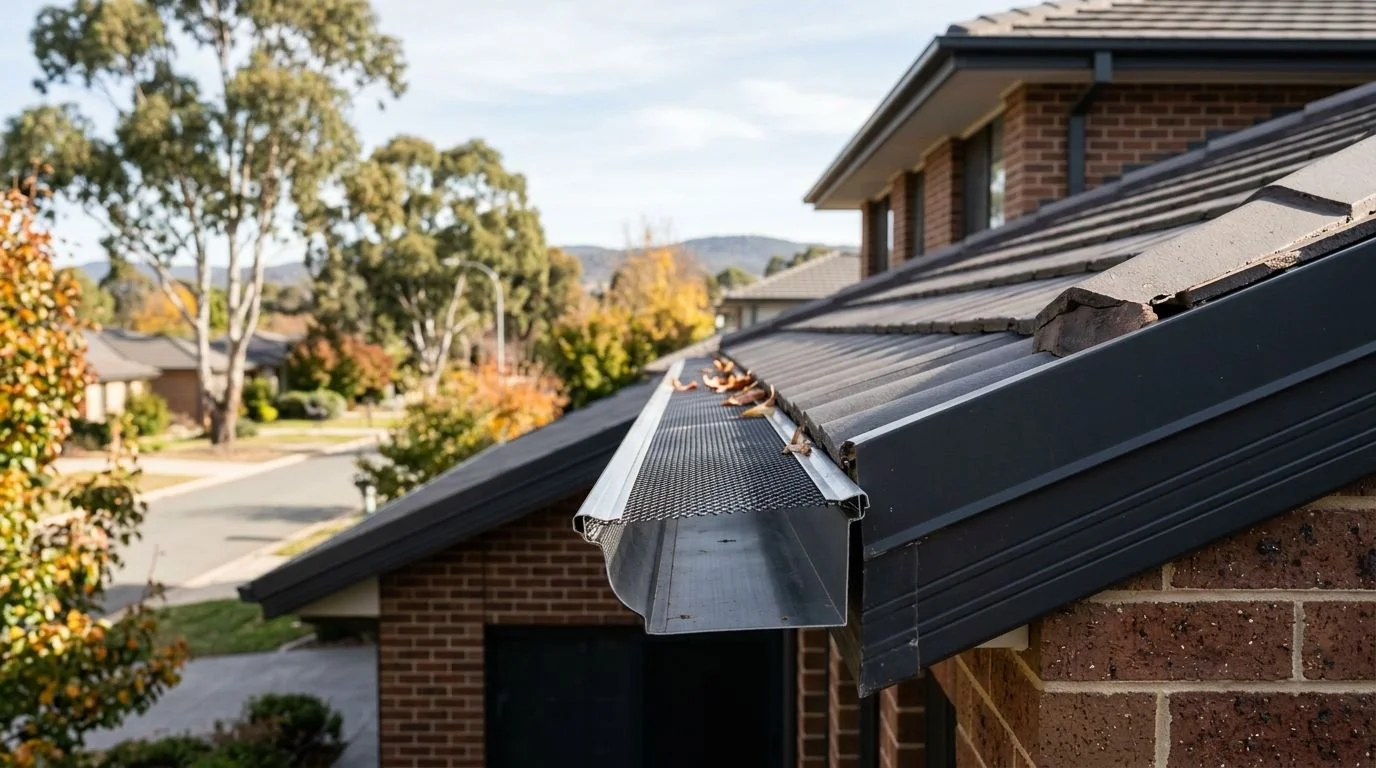
Best overall: micro-mesh aluminium. Best for heavy leaf-fall streets: reverse-curve (surface tension). Best for bushfire-prone blocks: perforated aluminium. Best budget: PVC brush.
If you are still on a ladder every few months scooping wet leaves, the guard is wrong — or there isn’t one. This ranks the five types sold and fitted across Canberra and the ACT in 2026, which one actually cuts cleans for your street, and where a guard is not enough on its own.
Micro-mesh aluminium is the default for most ACT roofs
Reverse-curve wins on tree streets with heavy autumn drop — nothing for leaves to sit on
Perforated aluminium suits higher BAL properties under AS 3959
PVC brush is the cheap retrofit; bristles flatten
No guard kills the annual check. A clean roofline before install makes any guard work better
Why this matters
Gums, pines and deciduous street trees fill ACT gutters fast. Frost then a dump of rain turns a block into overflow on fascias and render. Guards do not end maintenance. They change how often you climb and what happens if you skip a season.
Wrong type for the roof, the trees or the BAL and you pay for something that clogs like a bare gutter.
Before anything clips on, clean the edge. Moss, lichen and grit on the roof will sit under a new guard from day one. That is the job Clear Jet does — pressure clean the roofline, then you or a gutter fitter put the guard on a clean edge.
What actually matters
Aperture — finer mesh stops more junk, needs a brush-off on top
Material — aluminium and steel outlast PVC and foam
Bushfire — non-combustible mesh in higher BAL zones
Real interval between checks, not the brochure
Clip-in vs a full edge system
Quad, half-round and box do not all take the same guard
At a glance
Micro-mesh aluminium — overall control. Fine mesh. Occasional brush-off on top.
Reverse curve — heavy leaf streets. No holes. Weaker in very light rain.
Perforated aluminium/steel — bushfire blocks. Ember-resistant. Ash still builds.
PVC brush — narrow gutters, quick fit. Bristles flatten in a couple of years.
Foam — DIY wedge. UV kills it first. Can hold moisture and grow moss.
1. Micro-mesh aluminium
Clips over the gutter. Fine weave blocks leaves, gum nuts and needles and still lets water through. Closest to set-and-forget on a typical Canberra roof. Aluminium does not rust like old steel mesh.
Pros: almost everything except dust and pollen; handles frost-to-heat; Colorbond, tile, most profiles.
Cons: dearer than brush or foam; proper fascia seal wants a fitter; wipe after a big wind.
Best for: gums or pines and the longest gap between checks.
2. Reverse curve
No holes. Water follows the curve in; leaves slide off the front.
Pros: nothing to clog; heavy autumn drop; low maintenance once pitched right.
Cons: needs the right pitch and profile; weaker in drizzle; changes the look of the edge.
Best for: tree streets — Yarralumla, Aranda, anything with a heavy deciduous dump.
3. Perforated metal — bushfire
Small holes in a non-combustible sheet. In higher BAL zones this is the style that stops embers sitting in the gutter, in line with AS 3959.
Pros: non-combustible; rigid under leaf load; long life on tile and metal.
Cons: ash still builds; heavier to fit; overkill outside mapped zones.
Best for: rural-fringe ACT in a mapped BAL. Otherwise micro-mesh is enough.
4. PVC brush
Bristle strip in the channel. Water under, leaves on top. Fastest DIY fit on narrow old gutters.
Pros: cheap, no specialist tools, odd profiles.
Cons: seeds lodge; bristles flatten; you still pull it out and shake it.
Best for: a renter or a short stay. Not the long-term system.
5. Foam
Open-cell wedge. Water through, leaves on top. No clips.
Pros: any shape, cheapest, no fitter.
Cons: UV wrecks it; holds moisture; moss on top; replace, don’t just clean.
Best for: a stopgap. Skip if you want it to last.
If you are still on the ladder every three months, the guard is not doing the job.
Which one
Most Canberra homes: micro-mesh aluminium. Heavy deciduous canopy: reverse curve. Mapped BAL: perforated non-combustible. Brush and foam: short-term or rental only.
GET A FREE QUOTE
https://www.clearjet.com.au/#quote
(Roof and gutter clean before the guard goes on — we do not sell the guard.)
FAQ
Best overall in 2026?
Micro-mesh aluminium for mixed gum, pine and seed. Reverse curve where deciduous drop is the whole problem.
Do guards end cleaning?
No. They cut how often. Still do an annual check.
Required in bushfire zones?
Higher BAL expects non-combustible, small-aperture mesh under AS 3959. Perforated aluminium or steel.
Reverse curve vs micro-mesh?
No holes vs mixed debris. Pick from the trees on your street.
Foam worth it?
Cheapest DIY. Dies first in the sun. Short-term.
Quad and half-round?
Most mesh and brush adapt. Reverse curve is fussy about pitch and shape.
Clean first?
Yes. Grime under a new guard is there for good. Clean roofline, then fit.
One last thing
The bit most comparisons skip is the roof under the guard. Moss and lichen shed grit into the gutter all year. No guard on this list filters that. It only slows the leaves. Clean roof before install, then a periodic check, is what actually stretches the years between a full gutter clear.
GET A FREE QUOTE
https://www.clearjet.com.au/#quote
